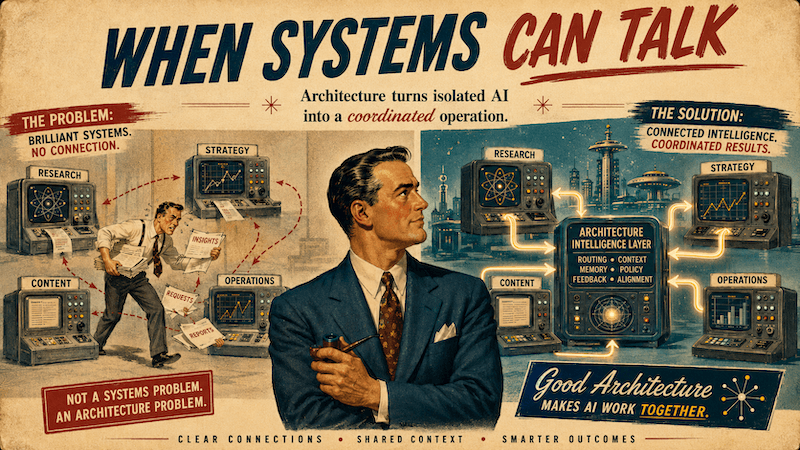
The problem most AI-powered organizations hit at scale is not that their systems underperform. It’s that their systems can’t communicate.
Each system runs cleanly in isolation, but somewhere between the research function, the content workflow, and everything downstream, someone on your team is manually carrying information from one to the next by hand.
That is not automation. That is the appearance of automation with a human doing the integration work in the middle.
I’ve spent over two years building AI systems for myself and for businesses, and this coordination problem is the most common ceiling I’ve seen. It doesn’t make itself known right away. It surfaces at scale, once an organization has built enough AI functions that the handoffs between them become the actual constraint on performance.
What Multi-Function AI Looks Like Without the Right Architecture
Anyone building AI across multiple functions ends up in the same place: a collection of capable, isolated systems that cannot share intelligence with each other in any structured way.
The research system produces a competitive analysis. A team member reads it, pulls the relevant pieces, and manually carries that information into the strategy or content workflow. The market intelligence stack surfaces a positioning opportunity. Someone interprets that finding and translates it into a format the next system can actually use. Each AI function performs well on its own, but the connective tissue between functions is still a person, doing interpretation and transfer work at every junction.
The cost doesn’t show up as a line item. It shows up as friction, as delayed decisions, as errors introduced at every handoff point, and as a ceiling on how sophisticated the overall operation can become before it gets unmanageable. The output quality across the entire system ends up being limited not by the strongest individual function, but by the weakest transfer between them.
This is the same dynamic driving the AI sameness problem I’ve written about elsewhere, where generic systems produce output that makes every business sound identical. The coordination failure compounds that problem at every stage of the workflow.
What does it actually cost to run AI systems that can’t coordinate with each other?
The direct costs are the hours your team spends manually moving outputs between systems, the errors that get introduced at each transfer, and the senior-level time consumed doing work that should be handled architecturally. The indirect cost is harder to measure but more significant: a ceiling on the scale and complexity your AI operation can reach, because every increase in capability increases the human coordination burden at the same rate.
Why This Problem Stays Invisible Until It’s Expensive
The coordination problem doesn’t surface when an organization has one or two AI functions. With a single system, there’s nothing to coordinate and everything runs cleanly. The friction only becomes visible once enough functions have been deployed that the handoffs between them accumulate into a measurable drag on the operation.
By the time the problem becomes visible, systems are already built that aren’t positioned to be rebuilt, manual transfer workflows have been accepted as a permanent feature of how things work, and a general assumption has set in that this is simply how multi-function AI operates.
It is how multi-function AI operates without the right architecture underneath it.
What separates isolated AI systems from a coordinated AI operation?
Isolated systems each carry the full context burden for their specific function and produce output that requires human interpretation before it can be used anywhere else in the workflow. A coordinated AI operation is architected so that the output of each function is structured to feed directly into the next one, with the coordination logic embedded in the system itself rather than delegated to whoever happens to be managing the workflow that day. Isolated systems plateau as complexity increases. Coordinated systems continue to compound.
The Architecture Layer That Determines Whether Your AI Operation Scales or Stalls
Most of the conversation in the AI space centers on the tool and agent layer: which platforms to use, which models to deploy, which workflows to automate. The layer underneath those tools, the context layer, receives almost none of that attention.
The context layer is the structured intelligence that determines how well every tool and agent actually performs. Without it, AI systems produce output that could describe any business in any market anywhere. That is the core of the AI sameness problem and why the context layer is the only thing that prevents it.
With it, each system has a precise understanding of who the business is, who their customers are, the specific language those customers use, how the business competes, and what it will never do.
This is also exactly what 180,000 REMAX agents are now facing: one platform, one AI, and nothing to separate any of them from each other. The context layer is what prevents that outcome.
The ReadyStacks Architecture Method™ is built on this premise. Every build starts with a deeply engineered context layer that governs how each AI system behaves, what it knows, and what rules it operates under. That foundation is what makes each individual system produce precise, business-specific output rather than generic content, and it is what makes coordinated multi-function operation possible in the first place.
Why is the context layer more valuable than the tool layer over time?
Tools change and models change, often faster than most organizations can adapt to. A deeply architected context layer, built around a specific business with specific intelligence about their market, competitors, customers, and voice, grows more valuable as it is refined and expanded through ongoing use. The tool layer is a commodity and the context layer is a moat.
How the Coordination Problem Gets Solved
Getting multiple AI systems to coordinate without requiring human intervention at every handoff takes more than good prompting and well-configured tools. It requires an architectural approach designed for coordination from the ground up, where each system is built not only to perform its specific function, but to pass structured intelligence to the next system in the workflow without loss of precision or context.
This is the problem I’ve spent the better part of two years solving. The methodology I developed to address it is what I’ve formalized as the Inter-Project Communication Protocol™, or IPCP™.
IPCP™ is the architecture that allows separate AI systems to function as a single coordinated operation. Each system remains purpose-built and tightly focused on its specific function. The coordination between systems is handled at the architectural level, which means the person running the operation is directing outcomes rather than managing the transfers between systems.
What makes a coordinated multi-project AI architecture different from simply connecting AI tools together?
Connecting tools produces integrations that still depend on human judgment at every transition point to interpret what came out of one system and decide what goes into the next. A coordinated architecture is built so that each system’s output is already structured in the exact form the next system needs to receive and act on it. The coordination is designed into the system from the beginning, not assembled after the fact.
What Changes When the Architecture Is Right
When each AI function in a multi-project operation is purpose-built for its specific role and the coordination between functions is handled by the architecture rather than the people managing the workflow, three meaningful things change.
Each function runs with deeper precision because it carries only the context relevant to its specific role, without the cognitive weight of everything happening upstream and downstream. Focused systems consistently outperform bloated ones at every level of complexity.
The operation scales without adding coordination overhead. Increasing capability means extending the architecture to accommodate the new function, not adding headcount to manage the new gaps it creates.
The person running the operation shifts from doing integration work to directing outcomes. The gap between what AI is capable of and what the business actually gets out of it closes, because the system handles its own internal coordination.
What does a properly architected multi-project AI system actually deliver in practice?
Precision at every stage of the workflow without the context overload that comes from trying to run all functions inside a single environment. Clean, structured transitions between functions that remove the manual interpretation layer entirely. A system whose capability compounds as it scales rather than degrading as coordination complexity increases.
This Is Proven, Not Theoretical
I’m delivering the first full IPCP™ implementation this week to a B2B SaaS client in the influencer marketing space. The build coordinates multiple distinct workflow stages, each with its own research requirements, output format, and processing logic. Every stage operates with the precision of a purpose-built single-function system. The coordination between stages is handled entirely by the architecture.
Enterprise-scale AI operations require two things working together: deep specialization at every stage, and clean coordination across all of them. That combination doesn’t come from adding more tools or spending more time configuring the systems you already have. It requires a different architectural approach from the beginning, and two years of building under real commercial conditions is what produced it.
Is a Coordinated Multi-Project AI Architecture Right for Your Operation?
The organizations that get the most out of this approach are those that have already deployed AI across multiple functions and are starting to feel the friction of managing the coordination between them by hand. If your team is spending meaningful time moving outputs from one AI system into another and interpreting what should happen at each transfer, the coordination problem is already limiting what your operation can do.
The solution is architectural and the diagnosis takes one conversation.
If you’re running AI across multiple functions and the coordination overhead between your systems is consuming the efficiency those systems were built to create, that is the problem ReadyStacks was designed to solve.