LinkedIn is now algorithmically suppressing generic AI content, and most of the businesses producing it have no idea it is already happening to them.
I have spent over two years building custom AI content systems for businesses, and the pattern I have been watching play out across every content channel just got a direct commercial consequence on the platform where most businesses have their most visible professional presence.
According to Entrepreneur magazine’s report on LinkedIn’s new AI content policy, Laura Lorenzetti, LinkedIn’s VP and Executive Editor, confirmed that content creation on the platform is up 14 percent year over year, and that a significant portion of that volume is generic AI-generated material the algorithm will now actively limit.
Posts classified as low-quality will not be deleted. They simply will not travel beyond a poster’s first-degree connections.
LinkedIn is not targeting businesses for using AI.
It is targeting content that lacks original insight, specific expertise, or a distinctive perspective. The problem is that most AI-generated content, produced without a system built on genuine business intelligence, fails that test.
For those businesses, this is not a reach problem. It is an invisibility problem.
The Real Issue Is Not That Businesses Are Using AI, It Is How They Are Using It
Let’s say a business owner or marketing team starts using AI to produce content and the output volume goes up immediately. Quality, measured by how much of the actual person or business shows up in the writing, goes down just as fast.
The tool defaults to what AI defaults to… competent, generic, industry-appropriate language that sounds like every other competent, generic piece of content in the same category. I have watched this play out the same way across countless businesses over the past two years.
LinkedIn’s algorithm is now trained to find exactly that pattern and reduce its distribution accordingly.
This is not a LinkedIn-specific problem. YouTube scripts read like they were assembled from the same five frameworks. Email sequences hit the same beats in the same order. Blog posts open with the same contextualizing statements before eventually arriving at their actual argument.
The AI sameness problem is running across every content channel simultaneously, and LinkedIn just became the first major professional platform to build an explicit, announced mechanical response to it.
And as you can imagine, being one shouting from rooftops about this problem that was coming with AI, while everyone looked at me like I was crazy, this is real validation.
And this is only the tip of the iceberg for what I expect to come in the coming months across small business to major corporations.
Content will always be king. The secret is creating a foundation and specific architecture that runs under the AI outputs that becomes the crown that governs everything.
What is LinkedIn’s algorithm actually targeting with this new policy?
LinkedIn’s updated system targets three specific categories:
1. Generic AI-written posts and comments that lack original perspective
2. Automation tools that generate comments at scale
3. Attention-bait videos that pair unrelated footage with vague business advice.
Posts in these categories will not be removed, but their distribution will be limited algorithmically, often confining them to a poster’s immediate network rather than allowing broader reach.
The underlying detection method uses human editors to label content as generic or original, then trains machine learning models to apply those classifications at scale.
It’s about to become AI vs. AI. Those of us using AI for content generation properly are not gaming the system, we are providing the system and humans with what they actually want to to see.
This article is a perfect example and I have zero reason to hide it. I used my own ReadyStack to create this article. But this is me, writing this text right now. I don’t just create AI content and post it. I read it, add any other thoughts or ideas that I feel adds value or more context.
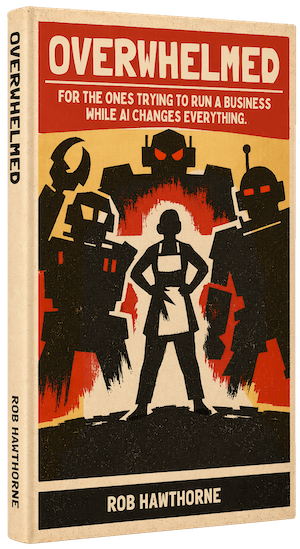
AI that is highly contextually architected gets me 98% there, I just sprinkle in a little bit of me in content that was already created by an AI that is highly trained on me. My book (linked at the bottom of this post) is a perfect example of this. No edits were needed, but I added a little of my own content when it made sense to do so.
What LinkedIn Is Actually Rewarding, and What That Requires
The content LinkedIn actually surfaces has one thing in common. It reflects a specific person’s direct experience, built expertise, or genuine perspective on something they have actually worked through.
That is a harder bar to clear than it sounds, because AI by default does not produce that. AI produces synthesis. It produces the competent middle of a topic. Reaching the standard LinkedIn is now actively enforcing requires training the system on something AI cannot access from a generic input: the actual thinking, voice, positioning, and operational knowledge of a specific business and the person running it.
That AI foundation problem is not new.
It is the same architecture gap I documented in the hidden layer that determines AI content output quality.
What a system produces is entirely a function of what it is trained on. A system trained on nothing business-specific produces nothing business-specific. The output is technically correct and operationally useless for differentiation.
Why does AI content from completely different businesses end up sounding identical?
AI language models produce content by predicting the most statistically likely next word or phrase given a prompt and their training data. When two businesses in the same industry use similar general prompts without deep business-specific context loaded into the system, they receive content built from the same statistical patterns.
The result is writing that is competent, grammatically sound, and indistinguishable from every competitor doing the same thing.
Voice, positioning, and specific expertise cannot emerge from a system that was never given access to them.

The Competitive Moat Is Not the Tool. It Is What the Tool Is Built On
Some small business owners I talk to are already using AI for content. Others have some reservations about AI, and I respect where they are at. Change, especially at the speed AI is advancing, is overwhelming. Every medium and large business I’ve spoken to not only uses AI, but they have been for a while.
The tool is no longer a competitive differentiator. What separates the businesses producing content that performs from the ones producing content that gets suppressed is the intelligence layer the tool is operating on.
A system built on deep knowledge of a specific business, its customers’ actual language, its genuine market position, and the owner’s real perspective produces something fundamentally different from a system operating on a general prompt. The output sounds different because it came from something different.
The businesses that recognized this early built their advantage into the system before the algorithm caught up to the problem. (Yes, there is still time, but the window is closing.)
That is the argument behind why AI architecture is the new competitive moat, and LinkedIn just handed it a concrete proof point.
The businesses operating on generic AI inputs are now facing algorithmic suppression on the platform where their professional presence is most visible, whether they realize it yet or not.
What actually separates AI content that LinkedIn surfaces from the content it buries?
LinkedIn’s detection systems are trained to identify content that lacks original perspective, specific expertise, or genuine insight. Producing content that passes that test requires building an AI system on a deep foundation that actually contains those things.
Things like: the business owner’s or brand’s real voice, specific positioning language drawn from how real customers describe their experience, various deep psychological profiles, genuine expertise signals that reflect what the person has actually built, seen, and learned, and dozens of other factors.
A system built on that foundation produces content that reads as distinctly human because it is drawing from something distinctly human.
A system operating on a generic prompt cannot replicate that output regardless of how sophisticated the underlying model is.
What This Means for Every Business Still Running Generic AI Content
LinkedIn’s rollout is gradual by design. Lorenzetti told Entrepreneur it may take several months to fully impact user experience. That window is useful, but it is not a reason to delay.
The businesses that build a content system grounded in genuine intelligence now will be producing content that performs as the suppression takes full effect. The businesses that wait will be diagnosing a reach problem after the fact, without a clear path to fixing it.
None of this is new. I have been tracking this pattern across AI content for over two years, and the AI sameness problem and what separates the businesses that do not fall into it documents exactly where it leads.
LinkedIn just attached a direct commercial consequence to something that was previously a brand differentiation argument. That changes the conversation.
If your business is using AI for LinkedIn content without a system built on your specific voice, positioning, and expertise, the content you are producing is likely already being suppressed.
You are not losing reach gradually. You are producing content that the platform is actively deciding not to show.
ReadyStacks™ builds the intelligence layer that changes what your AI system produces at the source.
If you want to know exactly what that looks like for your business (or for you personally so you can still use AI on LinkedIn), schedule a call with me.